
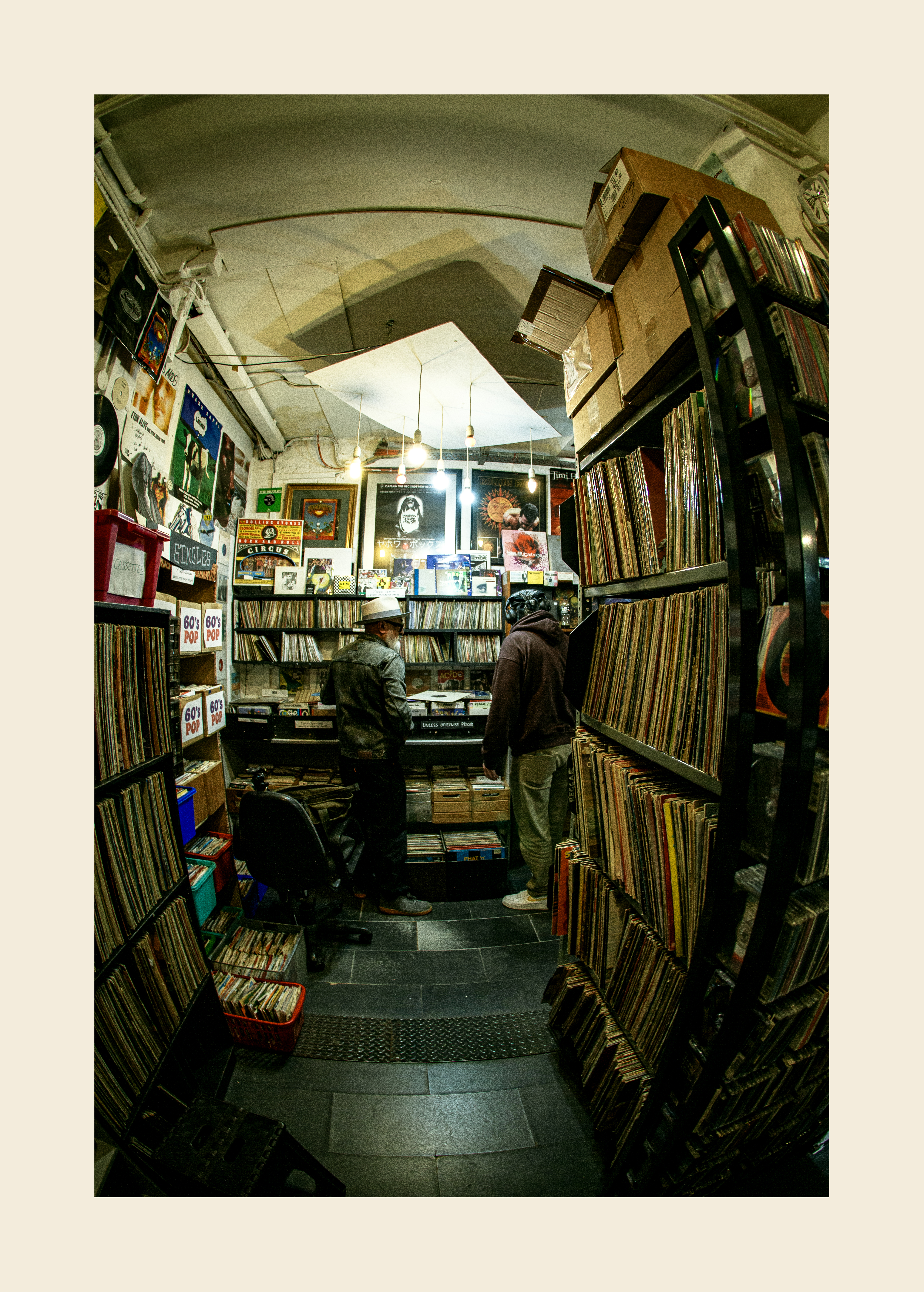

I’ve been fascinated by turntables since I was a child. I remember staring at the one we had at home, wondering how it worked—how sound could come out of it at all. Ours had pitch control, with a dial that adjusted the speed. As you turned it, the lights would shift and dance. When they finally stood still, you knew you’d hit perfection. That moment always felt special to me.
Records were always part of our home. My mum collected Indian soundtracks, while my brother and sister were into psychedelic rock, folk, and music coming out of the USA. Their taste went far beyond that. My brother, in particular, had a deep and varied collection—artists like John Coltrane and Archie Shepp sat alongside everything else. He was never tied to one genre.

My sister stopped buying records around the time of Adam Ant, but my brother kept going. As kids, we’d follow him around Birmingham while he dug through record shops, often stopping by the art gallery too. He was always more immersed than me—he cared about the history, the details, the stories behind the music.
By the time I started buying records myself, hip hop was in full swing. It was an exciting time for my generation. I was lucky—Birmingham still had a thriving record shop scene. There must have been 20 shops in the city at one point. Don Christies, Summit Records, Tempest, Plastic Factory, Baileys, Second City Sounds, the BRMB Shop ( where Spence worked) Unique Sounds Swinging Pig, Reddingtons Rare Records, Jibbering, Samebeat Records and Music Exchange were some of the Indi places I would go round


Over time, most of them disappeared. Looking back, I wish I had the knowledge then that I have now. Digging through those shops today would have been heaven—especially knowing that many records now considered valuable were once dirt cheap.
These days, only a couple of independent shops from that era remain in the city centre: The Diskery and Swordfish Records. Polar Bear Records, which has been around for over 20 years, sits out in Kings Heath. There were plenty of shops on the fringes too, but many have gone.
This piece is about some of the places I still go to—some I’ve rediscovered, others that deserve more attention than they get.


I have to start with The Diskery, one of the oldest record shops in the country. This place means a lot to me. Since I really got into digging, it’s been the one shop I’ve stayed loyal to.
What makes The Diskery special isn’t just the records—it’s the people. You might be offered a glass of wine, even a sandw
ich, while you’re digging. Conversations happen naturally, and you meet people with incredible stories. It’s a rare atmosphere.


Years ago, Jim and Liam ran the shop. I learned a lot there—we’d explore the racks together, uncovering hidden gems. Today, the shop is run by Lee and his son, who’ve kept that same spirit alive. At the heart of it all is Liam, possibly the longest-serving record shop employee in the UK—over 50 years at The Diskery. That’s an incredible feat.

I genuinely love these guys. They’ve been good to me and my family through some difficult times. When I was struggling financially, I still found myself there. It wasn’t about buying records—it was about the experience, the escape, being around good people. It’s more than a shop; it’s a space.


Recently, Lee has taken a step back, and his son Pete is stepping up. He’s got one of the best mentors in Liam, and to his credit, Pete already shows great musical instinct. He’s found his place.


The Diskery is royalty among record shops—but without the snobbery. It’s a place full of passion, knowledge, and community.
Next door is new food spot to check out. The Indian Cafe Racer. Very sheek and stylish food. They also do the catering in the Duke of Wellington on the corner.


Swordfish Records is next. I hadn’t visited in a while, and going back made me regret staying away so long. I used to go to the original shop on Needless Alley, then later Temple Street. Now it’s on Dalton Street, near the old Hummingbird venue.


I popped in to take a few pictures and ended up spending three days there. That says everything.
Swordfish has always been fair with pricing and strong on both contemporary and older records. Back in the day, they played a big role in indie, punk, and alternative scenes. I remember their deep connection to the Grateful Dead—you can still feel that influence in the shop today.\

The old Temple Street location had a back room that only opened on Saturdays, dedicated to used vinyl. I used to dig there regularly—and even filmed parts of King of the Beats 2 in both Swordfish and The Diskery.

The new shop recently acquired a huge collection. I missed some of the bigger records, but honestly, I’m more interested in the hidden sounds—the grooves no one’s heard. Even now, in the age of the internet, there are still moments when you find something that feels undiscovered. That’s what drives me.


Jake, who runs the shop, is a good guy with a fair approach to pricing. Swordfish is a must-visit—especially if you want a feel for what a proper 90s indie record shop was like.
On this day I got to spend the day with one my great friends and someone that taught me so much about looking for records. Damian from Samebeat records . Pictured Steve in the old shop. (Minor note I painted). Damian was the guy that taught me the formula that led me to make some impact at the Hockley Social Club with the customers. He is the master of how to play records. I Just added my personality, the music im into, the influence of my first true mentor DJ Sparra who I later mention. I really was a crate boy ( someone that learnt the craft carrying crates for his teacher ). That’s doesn’t happen now.


Another spot that doesn’t get mentioned enough is The Hatman. Known across the city for hats, their reputation is legendary. I still have hats I bought from them back when they had a market stall in the 80s and 90s.
What people don’t always realise is that they also stock records—reggae, soul, disco, hip hop, plus plenty of 45s. If you love Black music, it’s worth stepping inside.


There’s real craftsmanship in what they do. I’ve always loved hats, especially styles from the 80s and early 90s—that Masta Ace Take a Look Around kind of feel. And The Hatman is still keeping that alive.

Not far from there are two great places to eat that I Recommend. Firstly Bonehead run by Shamrez. One of the coolest people I have got to know over the years, his place has received international recognition His Store is in the old Samebeat Records location. The other place is Seoul Korean.


A spot well worth carving out time for on a Sunday wander is Redbrick Market. Just inside the entrance, there’s a modest but inviting corner dedicated to records — the kind of place where you might stumble across something you didn’t know you were looking for. It’s these unassuming spaces that reward a bit of patience; places like this deserve more than a passing glance.

A stone throw away are two spots ‘The Ruin’ That used to be home to Desert Island Discs and on Oxford Street the Abandoned pub that is planned to be re-opened as the Diggers Arms. As my clothing brand Diggers (formed in 2013) bears the same name..im looking forward to see what they bring to the table.


Not far off, and somewhere I’ve not visited nearly as often as I should, is Moseley Vintage. The last time I called in, they were tucked away upstairs, but much has changed since. Owners Stevie Divito and his partner have clearly poured themselves into the space, shaping it into a thoughtfully curated home for vintage furniture — now very much their main focus.Stevie, for some, will be a familiar name for another reason.


He was one of the driving forces behind Sweat, one of Birmingham’s defining club nights. Back in the early ’90s, it held real significance for me — a place where I’d regularly go to support my DJ mentor and close friend, DJ Sparra. Sweat was a hub for funk, soul and hip hop, and a meeting point for dancers and heads alike.
Years later, our paths crossed again at Hockley Social Club, both of us booked on the same roster — a reminder of how small and interconnected these scenes can be.I couldn’t leave Moseley Vintage out of this story, so I stopped by to see what records they had in. There’s a genuinely interesting selection — the sort that invites a proper dig rather than a quick flick. As it turned out, I found something I’d been searching for over the years, which says everything about the place.


You’ll find it in Digbeth, at C1 Bowyer Street — just a short three-minute walk from The Rainbow pub, home to Baha, the award-winning vegan kitchen that’s been quietly making national waves. Close by, too, is Deadwax, the base for the Desert Island Discs crew. And if you’re driving in, there’s the added bonus of a surprisingly large car park — a rarity in town, and reason enough to start your visit there.


Out in Kings Heath, you’ve got Polar Bear Records. It’s easy to feel overwhelmed walking in—there’s a lot to take in. While many records are modern represses, Steve, the owner, has excellent taste across genres.


Rock, soul, indie, metal, African, jazz—you name it. And if you don’t find what you’re looking for, you’ll almost certainly discover something new. I often come across records I’ve never seen before.
Steve is always encouraging—he’ll suggest taking a picture, checking things out before buying. That kind of approach matters.
Some people are against represses, but I see it differently. There’s so much great music being reissued—sometimes from artists who were overlooked the first time around. Good music is good music.
Found my good friend and great DJ, Tom of Blackmarket Barbers in their digging. Lucky for him he works next door.


Finally, there’s Urban Village in Henley-in-Arden. It’s a bit further out, but worth the trip. Originally in Digbeth’s Custard Factory ( Some pictures below from the Custard Factory below, taken by Mazena Klajbert), then Hurst Street, Frankie moved it to this beautiful high street location.


This place is seriously overlooked, and one of my favourite places to go.


The selection is strong—disco, boogie, house, soul, jazz, 80s pop, loads of 45s. It’s very DJ-friendly. The pricing is fair, and the staff are welcoming—there’s something about that Brummie spirit.

It’s more than a record shop too—you’ll find vintage clothing and other gems. I even picked up a reel-to-reel there once.
This place became an escape for me, especially during difficult times. I’d go just to dig, even if I didn’t buy anything—just searching for that perfect sound.


I first went there with my friend Matt Williams, who sadly passed away in 2024. We’d go digging together. After he passed, I found myself going back often. It became a place to reflect, to reconnect. Local to the U.V are a few great spots to eat. First is Cafe 86B which has had a make over. This is where me and Matt last hung out. The other spot is of all places a spot where you can get ice Cream. Henley is famous for making ice cream. So if you fancy a day out digging check there are some decent places to get food.


In-between Redditch and Henley is this Barn that’s only open on Friday and Saturdays. Not a records specialist but they have some records. the picture I took below was taken on the morning of my fathers Birthday. It features Rich and Paul S ( P -Brothers) from Nottingham that came to see me and go for a dig them selves.

All these shops are different, but each one is special in its own way. They’ve got character, personality, and energy. They deserve to be supported—not just as shops, but as cultural spaces.
There was a time when Birmingham was full of record stores. That’s no longer the case. This is 2026.
So go and visit these places. Experience them. And if you found them through this, let them know.
For me, it’s important to celebrate the places that have given me something real.
More stories to follow.

Leave a Reply